Kabwe is the capital of the ZambianCentral Province with a population estimated at 202,914 at the 2010 census. Formerly named Broken Hill, it was founded when lead and zinc deposits were discovered in 1902. Kabwe also has a claim to being the birthplace of Zambian politics as it was an important political centre during the colonial period.[1] It is an important transportation and mining centre.
The name Kabwe or Kabwe-Ka Mukuba means 'ore' or 'smelting' but the European/Australian prospectors named it Broken Hill after a similar mine in Broken Hill, New South Wales, Australia.[2] The mine was the largest in the country for around thirty years until it was overtaken in the early 1930s by larger copper mining complexes on the Copperbelt. Apart from lead and zinc it also produced silver, manganese and heavy metals such as cadmium, vanadium, and titanium in smaller quantities.[3]
The mine, which occupies a 2.5 km² site 1 km south-west of the town centre, is closed but metals are still extracted from old tailings. A study by the Blacksmith Institute found Kabwe to be one of the ten most polluted places in the world due mostly to heavy metal (mostly zinc and lead) tailings making their way into the local water supply.[4] A recent report indicates that children's blood lead levels continue to be elevated even though mining has stopped.[5]
Headquarters of Zambia Railways
The first railway in the country, operated by Rhodesian Railways when the territory was administered as North-Western Rhodesia and North-Eastern Rhodesia, reached the Broken Hill mine as early as 1906, and the town became the northern base for the railway, which was the second biggest employer after the mining industry. A locomotive maintenance facility was constructed there. In 1909 the railway reached Ndola in what was to become the Copperbelt.
The railway workers' unions played a large role in the politics of the country. In racially segregated colonial times before Africans had the vote, the town was the seat of Roy Welensky, leader of the powerful Rhodesia Railway Workers Union (RRWU), who became Prime Minister of the ill-fated Federation of Rhodesia and Nyasaland, which was opposed by the Northern Rhodesia Railway Trade Union (the black Africans' union) led by Dixon Konkola and also based in Kabwe.[1]
Today, the town is the headquarters of Zambia Railways but employment levels on the railway have been heavily cut.
Kabwe's role in Zambia's independence
Reflecting Kabwe's central location and railway union base, it was chosen as the site for a rally held on October 26, 1958 at Mulungushi Rock north of the city by the Kaunda-Kapwepwe breakaway group from the Zambian African National Congress. Later, they founded the political party UNIP which led the successful independence movement and continued to hold conferences at Mulungushi Rock, which became known as the 'birthplace of independence' in Zambia.[1]
Transport links
The town's name was changed to Kabwe in 1966, shortly after independence. As well as being on the main Lusaka-Copperbelt railway line, it lies on the Great North Road. To the east of the city are the hydro-electric power stations of the Mulungushi Dam, Mita Hills Dam and Lunsemfwa Falls, built to power the mine and town.
Industries and agriculture
Closure of the mine led to economic decline for Kabwe.[2] It has a number of manufacturing industries including the Zambia-China Mulungushi Textiles plant established with Chinese investment in the 1980s, but after suffering large losses this plant closed (temporarily according to management) at the beginning of 2007.
Other industries include pharmaceuticals, milling and cotton ginning, and leather tanning.[2]
Commercial farming areas surround the city about 10 km from the centre, and the road and rail links provide ready access to the markets of the Copperbelt and Lusaka.
To the east and west of Kabwe are a number of areas with good but so-far undeveloped tourist potential, advantaged by Kabwe's central location and proximity to Lusaka and its international airport:,[7][8]
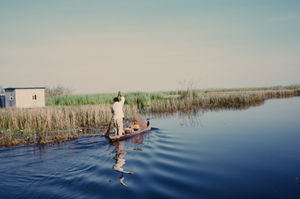
Lukanga Swamp: 50 km west, with a wildlife area (currently a Game Management Area) on the other side of the Kafue River, 120 km from Kabwe, but road access is very poor. File:Fisherman Lukanga Swamp.JPGA resident fisherman enters Lukanga Swamp about 60 km west of Kabwe, Zambia. Fisher families live in papyrus shelters on floating mats of vegetation within the swamp. The national bird, the fish eagle, may be seen hunting for its prey in the swamp.
Mulungushi River & Lunsemfwa River valleys, including Lunsemfwa Wonder Gorge: these two rivers flow into the western end of the Luangwa Rift Valley just over 50 km south-east of Kabwe, and just south of the Mulungushi Dam and lake which offers good boating and game fishing activities. The valleys are scenic wilderness with good wildlife potential. However, there is no proper road access to the area. About 75 km east-southeast of Kabwe, Zambia, the Lunsemfwa River cuts a 500m deep gash, known as The Wonder Gorge, through the lip of the Muchinga Escarpment (viewed from Bell’s Point). The antenna atop the Taipei 101 skyscraper, the world’s second-tallest building, would just protrude above the rim of this gorge.
Chifunkunya Hills: 150 km east, a wilderness area of rugged granite mountains rising 1000 m above the Luangwa Valley, just to the north-west of the confluence of the Lunsemfwa and Lukusashi Rivers, with no road access.
Radio Maranatha 103.3 FM, run by the Zambia Union Conference of the SDA Church
Kabwe Warriors football club, one of the top three teams in the country
Bwacha House National Monument: Number E1376 Musuku Road, Bwacha Township, where on 8 March 1958 Kenneth Kaunda was elected President of the Zambian African National Congress
Big Tree National Monument: a fig tree with a 50 m wide canopy on the east side of Broadway, which served as a meeting place on many occasions during the early years of the town's history
The remains of an extinct hominid referred to as Rhodesian man or Kabwe cranium were found in a cave located in Kabwe by miners in 1921. At that time it was the oldest hominid fossil ever found.
References
Terracarta/International Travel Maps, Vancouver Canada: "Zambia, 2nd edition", 2000.
External links
Lua error: callParserFunction: function "#coordinates" was not found.
Lua error in Module:Authority_control at line 346: attempt to index field 'wikibase' (a nil value).
↑ 1.01.11.2The Times of Zambia online, website accessed 8 March 2007: "Kabwe: the nucleus of national politics" by Kelvin Kachingwe.

 Zambia